
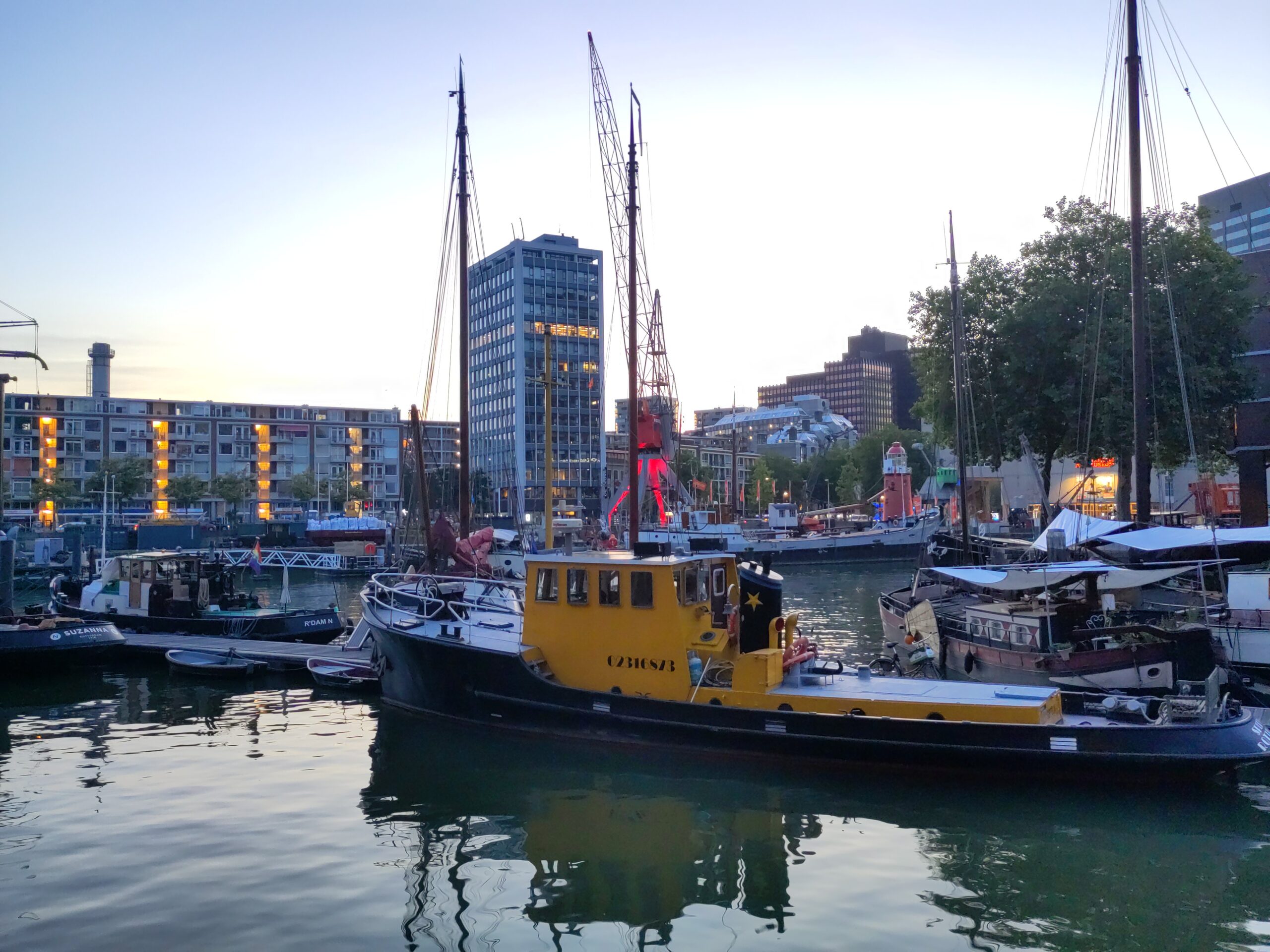
Under the name Sperwer, the ship served as a fisheries inspection vessel and police boat in the waters off Zeeland until the mid-1950s. According to tradition, it was used to check that the mesh size of the nets was not too small, which could result in the capture of undersized fish. This is also said to be the reason for its flat bottom. In the 1950s, it played a role in the management of the Delta Works project.
The ship was subsequently moved to the port of IJmuiden. Its name was then changed to “Wijkermeer,” “RHD (Rijkshavendienst) IV,” and “RHD 64.” It was there that she acquired her distinctive yellow color. Around 1980, the ship was taken out of commercial service; since then, it has had five different owners.
Unlike a tugboat, the ship has a high foredeck (bakdekker) and a relatively small engine. This provides a relatively large amount of living space. The headroom is also considerable, allowing the current owner—who is nearly 2 meters tall—to stand upright almost everywhere.
Other details: The ship was equipped with a Becker rudder for a period of time, and it has an icebreaker bow; displacement: 63 m³